Tuesday, September 22, 2015

Mystery History - The Salem Witchcraft Trials End

It was on this day in 1692 that seven men and women were hung after they were convicted of witchcraft in Salem, Massachusetts. Used as inspiration by dozens of artists, musicians and writers, the events stun us even today. How did the town descend so rapidly into chaos and madness?

The town of Salem had seen an influx of refugees from the devastation of King William's War in 1689. The strain on resources among the town folk caused a great deal of conflict between the established wealthy and powerful families and the newcomers. By the time the trials ended, the hysteria surrounding the accusations had claimed twenty innocent lives.

 It began when some of the teen-aged girls became to bark and yelp like animals and reported seeing strange things. They soon accused their afflictions on three women, one a slave, one a beggar, another an impoverished old spinster. A panel of male judges declared them witches and held them for trial. A declaration of innocence did the women little good. When some of them spoke, the girls broke into convulsions, and this was seen as proof of the accusations. One confession was even extracted from a four year old child!

Some victims were accused simply because they declared that the did not believe in witches, such as Martha Cory (she was one of the women hanged this day). Her husband, Giles, defended her and was also accused. Refusing to enter a plea or recognize the authority of the judges, he was punished by being slowly crushed to death.

After the Governor of Massachusetts received news of the trials he put a stop to them. He barred further trials, released the remaining accused and disbanded the court.

Today, the Salem witch trials have come to represent hysteria and xenophobia at their worst, and the events inspired numerous works of literature.

Arthur Miller used the trials as inspiration for his play The Crucible. Shirley Jackson's short story, The Lottery, is said by some to have been inspired by the trials. And elements of teenage angst and hysteria are prominent in Megan Abbott's novel, The Fever (although the author points more directly to strange events in an upper New York state town as her direct inspiration).

A complete list of cultural references to the Salem Witch trials in art, music and literature would be enormous and beyond the scope of this blog, but a partial list is featured here.


Sunday, September 20, 2015

Writers Born Today - Barbara Callahan

It's the birthday of Barbara Callahan, born September 20, 1934 in Philadelphia, Pennsylvania. After graduating college she became a teacher and later a technical writer. Most of her energy went into raising a family (she had five children). But she began to write in the spare time she could find.

Her contribution to the mystery genre was small in quantity, but not quality. She published 22 short stories during her life. Many of them appeared in Ellery Queen's Mystery Magazine. She's recognized as an important contributor to the mystery genre now known as Domestic Suspense.

Her second story, Lavender Lady, was nominated for an Edgar Award by the Mystery Writers of America. It was published in EQMM in April 1976. The haunting tale made such an impression on editor Sarah Weinman that she included it in her 2013 anthology Troubled Daughters, Twisted Wives.

My Mother's Keeper, also published in EQMM, was published in 2009 and nominated posthumously for a Barry Award the following year. It was the last story published before her death. You can read it here.


Note: Special thanks to Sarah Weinman, whose research and help made this posting possible.

Thursday, September 17, 2015

Writers Born Today - John Creasey

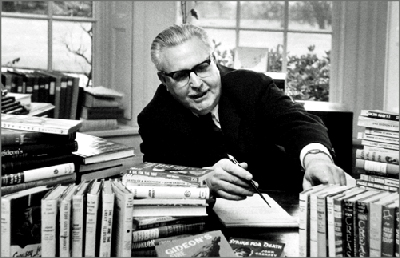
It's the birthday of John Creasey, born September 17, 1908 in England. He came from a working class family, and work he did. Depending on who you ask, he wrote somewhere between 560 and 620 novels using more than two dozen pen names (as well as his own). A complete bibliography of his work has never been assembled, and even Creasey admitted he could not remember all of them.

A teacher suggested he would make a career as a writer when he was just 10 years old. He took the advice to heart and began writing while still a teenager. Despite his dedication, he was rejected over 700 times. In his early years he wrote while working odd jobs to support himself, and produced up to 7,000 words a day on average.

By 1935 he was writing full time and publishing several books a year under different pen names. (Book sellers complained that he monopolized the letter "C" on their shelves).

He created two famous and lasting protagonists, Richard Rollinson (the Toff), an amateur detective, and George Gideon of Scotland Yard. Both of these characters made their way onto film and television. 

In 1962 the Mystery Writers of America awarded him an Edgar for Best Novel for Gideon's Fire. The organization honored him again in 1969 by making him a Grand Master.

He sold over 80 million books by the time he passed away in 1973.

Sunday, September 6, 2015

Writers Born Today - Richard Henry Sampson

It's the birthday of mystery writer Richard Henry Sampson, born September 6, 1896 in London. He wrote under the pen name of Richard Hull and achieved instant success with his first novel, The Murder Of My Aunt, published in 1934 to critical acclaim. But before he turned to writing full time he worked in private practice as...an accountant!

Sampson's early years held little clue that the man who entered figures in a ledger would someday spend most of his time pondering how to kill his victims for entertainment. After attending school in Warwickshire, he joined the army when World War I broke out. He became an officer in the infantry and served with distinction. After the war he became an accountant and eventually opened his own firm. He began writing after reading Malice Aforethought by Frances Illes, a work which made a powerful impression on him.

After the success of The Murder Of My Aunt, Hull published 14 more novels. He was well known for his wit, displayed in many of his novels. In 1940, he published a novel My Own Murderer in which the villain's name was Richard Henry Sampson.

He was a member of The Detection Club, a group of mystery writers who agreed to write novels that would give the reader a fair chance to guess "whodunit".

Tuesday, September 1, 2015

Women Crime Writers of the 1940s & 1950s. An Interview with editor Sarah Weinman

Sarah is the news editor for Publisher's Marketplace, and the editor of the short story anthology Troubled Daughters, Twisted Wives. She is also editor of the just released Library of America two volume set  Women Crime Writers of the 1940s and 1950s and one of today's top mystery fiction critics.

Welcome Sarah. Thanks for talking with me today.

1) Tell us about the birth of Women Crime Writers. And how did you convince the Library of America that this remarkable collection belonged on bookshelves?

To tell you the truth they didn't need much convincing! A mutual professional acquaintance put me in touch with Max Rudin, publisher of the Library of America, not long before TROUBLED DAUGHTERS, TWISTED WIVES was published a couple of years ago. We had a meeting and it emerged they had been thinking of doing such a set for some years now, what with the success of their original late-90s CRIME NOVELS OF THE 1930s/40s/50s 2-volume set edited by Robert Polito. One meeting led to the next and by the end of 2013 I was in board to edit what became WOMEN CRIME WRITERS.


2) Many of the novels that appear in this anthology were best sellers in their day, both in print and in movie versions. How did they slip from our memory in the first place?

Writers fall out of fashion or circulation for any number of reasons: changing tastes, changing fortunes, and having a next-generation champion at just the right time. In the 1980s, Barry Gifford, through Vintage Black Lizard, revived many reputations of those who toiled in the trenches of Fawcett Gold Medal and other paperback original publishers of the 1950s and 1960s, and those guys -- David Goodis, Jim Thompson, Peter Rabe, to name a few -- got written up and celebrated. But in parallel was this whole generation of women writing for hardcover publishers and garnering critical acclaim and yet, by not writing stories that fit the Black Lizard mold, they didn't make it in the revival. But now psychological suspense is all the rage, and it's important to recognize those who came before the Gillian Flynns and Paula Hawkins and Laura Lippmans of the world.


3) You've done more than anyone in the mystery field to identify and promote the sub-genre now known as Domestic Suspense. What exactly is Domestic Suspense? And is it a unifying theme in this collection?

I define "domestic suspense" as works written between the onset of World War II and the dawn of second-wave feminism, that delve into the dark side of human behavior that threatens to come out with the dinner dishes, the laundry, or taking care of a child. They are about ordinary, everyday life, and that’s what makes these novels of domestic suspense so frightening. The nerves they hit are really fault lines.


4) Some of the choices you made in Women Crime Writers may have seemed inevitable (for example, The Horizontal Man and Beast In View both won Edgars). But how did you decide what else to include?

The eight volumes were a consensus choice between myself and the Library of America editors, i.e publisher Max Rudin and editor-in-chief Geoffrey O'Brien. We all made lists and read widely but we started with some fairly obvious choices: LAURA by Vera Caspary, IN A LONELY PLACE by Dorothy B. Hughes, THE BLANK WALL by Elisabeth Sanxay Holding. That Charlotte Armstrong and Margaret Millar would be included were also obvious, but finding the right book of theirs took a little time. Eustis I read during the selection process and its influence and critical importance was clear. Dolores Hitchens I also loved but FOOL'S GOLD was not as well known as her later novel SLEEP WITH SLANDER -- published too late for the collection in 1960 -- and a little more difficult to come by. The Highsmith was the final choice, and THE BLUNDERER is a key linchpin because you see all the seeds of what would become THE TALENTED MR. RIPLEY and other later, important works of hers.


5) The website you created to introduce Women Crime Writers (http://womencrime.loa.org) is packed with essays, information and fascinating trivia about the anthology and the writers. Did you organize it yourself?

Again, the companion website was a total collaborative effort. I solicited the appreciations and wrote an introductory essay, while the LoA team assembled that amazing timeline of ancillary works, images of first edition covers, film posters, and more, and then some. It was months in the making and I'm so pleased at how it turned out, into a real destination that readers can get lost in for hours at a time, for repeat visits.


6) What's next? Is there a possibility we might someday see an anthology of International Women Crime Writers of Domestic Suspense?

I am the type of person who has multiple projects on the go and sees where the chips fall. But as to your anthology idea, it's a good one, and certainly in my wheelhouse.


Thanks again for allowing my readers to re-discover these remarkable women. Good luck with the tour.

Saturday, August 29, 2015

Spend a few hours with The Last Four Days of Paddy Buckley.

Pity Poor Paddy. His pregnant wife died 2 years ago and he hasn't been the same since. He just walking through life like a zombie. But this half-life, such as it is, just got very precious to him. He's just killed a man.

Sure, it was an accident. A pedestrian jaywalking on a dark rainy night, a brief distraction from the radio, the sound of a thump, and his life is changed. Things go from bad to worse when Paddy realizes who he's killed...Donal Cullen, brother of the most powerful gangster in Ireland. His initial thought was to seek help. But after the shock of his discovery this idea is tossed to the street to be washed into the sewer like the rain. His instinct is to flee, and he follows it. There are no witnesses...he assumes.

He barely has time to gather his wits around him when he is called into the office the next day and given a new assignment, which takes him face to face with Vincent Cullen...the dead man's brother.

Paddy, you see, works for a funeral home. He's been given the job of burying the very man he killed.

Mother said there'd be days like this. If only we had listened.

Not all is bleak for Paddy, however. He's also fallen in love with the daughter of one of his clients. The whirlwind romance feels solid, perhaps a second chance at redemption. But he's pursued by the fear of exposure that haunts his every move. At any moment, someone may point an accusing finger and reveal him a hypocrite and murderer. What's worse, his crime exposes not only him to danger, but the woman he loves, and if Vincent Cullen learns his secret, even the innocent will suffer.

Jeremy Massey has written an amazing debut novel. The Last Four Days Of Paddy Buckley is a thriller and a romance wrapped into a story that I couldn't put down...and neither will you. The writing is like poetry, the characters like the friends you haven't seen for years but can't forget.  After you're done, you'll savor it and want to read it again. Then you'll wonder...when will his next novel come out? And can you wait that long?


Friday, August 21, 2015

Writers Born Today - H.P. Lovecraft

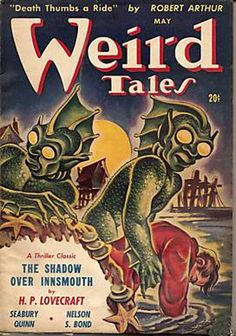
It's the birthday of H.P. Lovecraft, born August 20th 1890 in Providence, Rhode Island. When he died, he was virtually unknown. Only a few of his stories had been published. Yet today he is recognized as one of the most influential writers of modern times. He knew and befriended many great authors of early science fiction and horror, including August Derleth, Clark Ashton Smith, Robert Bloch and Robert E. Howard. They became known as The Lovecraft Circle, due to Lovecraft's influence on their writing. He corresponded with dozens of writers and edited countless stories without taking credit. Stephen King said he was "the twentieth century's greatest practitioner of the classic horror tale," and credited Lovecraft with King's interest in horror and the macabre.

As a writer of horror Lovecraft was a genius, and coined the phrase known by even non-Lovecraft fans, “The oldest and strongest emotion of mankind is fear, and the oldest and strongest kind of fear is fear of the unknown.”

His health was frail for most of his life. As a result he did not graduate from high school. But he studied on his own and was well read in science and astronomy. He was generous with his editorial assistance to fellow writers, but his own contributions to magazines such as Weird Tales brought him little money. By the time he died of cancer in 1937 he was broke.

After his death, August Derleth worked to maintain Lovecraft's reputation and increase interest among readers. Derleth even started a publishing company named Arkham House (named after a setting in Lovecraft's stories) with the express purpose of publishing Lovecraft's work. His fans bought him a tombstone in his home town of Providence. And in 2005, the Library of America honored him by publishing an edition of his stories, H.P. Lovecraft: Tales.