Showing posts with label Mystery Writers of America. Show all posts

Wednesday, May 6, 2026

WRITERS BORN TODAY - JEFFERY DEAVER

 It's the birthday of Jeffery Deaver, born May 4th in Chicago. As befitting someone who was born in Chicago, he has been fascinated by crime from a young age. This led him first to a career in journalism, and then to the legal profession. 

Both of these choices provided ample opportunity for criminal activity, but at some point he must have determined that the risk/reward ratio was not in his favor. Thus, he turned to writing.

Fortunately for us, his interest has been used to create over 40 novels as a best selling crime writer, including one of his best known novels, The Bone Collector. One of his biggest inspirations was Ian Fleming, creator of the James Bond novels. He has also credited Alfred Hitchcock, Raymond Chandler, and Agatha Christie as models. 

But he hasn't limited himself to the old masters. Some of his work has been inspired by changes in technology, resulting in the frightening novel, The Blue Nowhere, where his protagonist pursues a murderous hacker who kills using the internet.

His most famous hero is Lincoln Rhyme, a quadriplegic detective, who has been described by critics as a modern day "Sherlock Holmes", due to his intellectual skills. This character, along with his partner Amelia Sachs, has appeared in 16 novels, and has a special appeal for his creator.


Although his novels have been described as a "ticking-clock" while the story races to the end, Deaver's writing process is anything but seat-of-the-pants. He spends several months outlining his novel, and can wind up with 200 pages in his outline before he even starts to write Chapter One. Then when he is finished, he rewrites the book as many times as needed to create his award winning novels.

In 2021 he received the Grand Master Award from the Mystery Writers of America in recognition of his contributions to the crime writing genre.


Photo Credit: Niko Giovanni Coniglio


"As Hemingway said, there are no great writers, only great rewriters."  - Jeffery Deaver


Friday, April 24, 2026

WRITERS BORN TODAY - SUE GRAFTON

It's the birthday of crime writer Sue Grafton, author of the Alphabet series, which featured wise-cracking P. I. Kinsey Millhone. The first novel in this series, A Is For Alibi, was nominated for a Shamus Award for Best Novel, but lost to Lawrence Block's Eight Million Ways To Die.

Sue's writing career started long before her award winning series took off and led to best sellers and critical acclaim. The story starts with her birth in Louisville Kentucky to a mother who was a teacher and a father who was a lawyer (with a two year stint in the army during WWII). It was her father, C.W. Grafton, who planted in her the writing bug. He wrote crime novels at night and published four during his short career. His first novel, The Rat Began To Gnaw The Rope, won the Mary Roberts Reinhart Award in 1943.

Her father taught her vital writing techniques and inspired her to start her first novel at age 18. Sue wrote seven novels in those early years, two of which were published, but these did not bring her commercial success.

Sue Grafton's Alphabet Series got it's inspiration from a bitter divorce and custody battle with her husband. While she fantasized about creative ways to kill him in order to preserve her sanity, she started writing down her thoughts. As she later described it, she wrote out her frustrations because she didn't want to spend the rest of her life in prison wearing a drab outfit.

Over the next 35 years the series extended through the alphabet all the way to Y is For Yesterday, published in 2017. Sue Grafton passed away on December 28, 2017. This left her last planned novel, Z Is For Zero, unfinished.

In  2009, Sue Grafton was awarded the Grand Master Award by the Mystery Writers of America in recognition of her contribution to the crime genre.

"Ideas are easy. It’s the execution of ideas that really separates the sheep from the goats." - Sue Grafton

Wednesday, March 9, 2016

Writers Born Today - Mickey Spillane

It's the birthday of Frank Morrison Spillane, born March 9, 1918 in Brooklyn. His father, an Irish bartender, gave him the nickname "Mickey". He developed a knack for story telling...it helped him avoid beatings by older kids in his tough neighborhood. By the end of high school, he had sold his first story to a pulp magazine. After some college he got a job writing comics. World War II interrupted his literary pursuits and with scant success in the comic trade, Spillane turned to writing novels using Mike Danger, a P.I. hero he created for the comics. He renamed the character Mike Hammer, and churned out the first novel with this hero in just three weeks. The publisher, E.P. Dutton, didn't think much of the writing, but bought it anyway, in part as a favor to Spillane's agent. It would change the publishing industry.

I, The Jury sold a respectable 10,000 copies in hardcover, but when released in paperback, sales exploded, literally. Over a million copies were sold, and Spillane churned out half a dozen more novels in the next few years featuring his hard hitting and often brutal hero. Spillane's timing was perfect. Paperbacks were cheap and fed the public's postwar demand for action and adventure filled stories.

Literary gems they were not. A new Mike Hammer novel brought enormous sales, but also scathing reviews from book critics. Anthony Boucher in the San Francisco Chronicle wrote of I, The Jury ,"so vicious a glorification of force, cruelty and extra-legal methods that the novel might be made required reading in a Gestapo training school."  The Saturday Review of Literature was more succinct. "Lurid action, lurid characters, lurid writing, lurid plot, lurid finish. Verdict: Lurid"

But Spillane didn't let the bad reviews bother him. "I don't give a hoot about readin' reviews. What I want to read is the royalty checks," he said. And the checks poured in, not just from print, but from television, radio and movie rights. One of the most successful screen adaptations was the movie Kiss Me Deadly, which starred Ralph Meeker as Mike Hammer. In real life, Spillane bore little resemblance to his hard as nails hero. He was a Jehovah's witness, and neither drank nor smoked.

Spillane created other protaganists, including spies Tiger Mann and Mako Hooker. He even wrote a few children's books and won a Junior Literary Guild award for one of them, The Day The Sea Rolled Back.

By the time he returned to writing Mike Hammer novels in the 60s, his literary reputation was improving. In 1995, the Mystery Writers of America gave him the Grand Master, the highest award in the mystery field in recognition of his lifetime achievements as a writer.

To date, his novels have sold over 200 million copies.


"Those big-shot writers could never dig the fact that there are more salted peanuts consumed than caviar."


                                                                                 - Mickey Spillane

Tuesday, January 19, 2016

Writers Born Today - Edgar Allan Poe

Mathew Brady [Public domain]
It's the birthday of Edgar Allan Poe, born January 19, 1809 in Boston.

His contributions to American literature are unequaled. He invented the detective novel with his character C. Auguste Dupin when he published The Murders in The Rue Morgue. Without his tales of detection, there would be no Sherlock Holmes. His horror stories inspired H.P. Lovecraft, Steven King, and Alfred Hitchcock, to name only a few. Yet by the time he died in 1849, he was penniless. Only seven people attended his funeral.

 Being the child of two actors may have set the stage for his tumultuous life. By the age of three he was an orphan, and although he was taken in by John Allan, a wealthy tobacco planter from Virginia, his luck didn't seem to change much.

He was a brilliant student, but debts and poverty forced him out of school. Twice he fell in love and twice his love was taken from him, either through death or estrangement. When his stepmother died, his stepfather did not even inform Poe that she had been ill for a long time, and he arrived too late for the funeral.

Poe's relationship with his benefactor, John Allan, was always strained. While at college, Poe racked up thousands of dollars in debt, debt that Allan refused to help pay. As a result Poe had to drop out of school and seek employment. To earn a living (and some say, to dodge his creditors) Poe joined the army. Upon Allan's death, Poe discovered that he had been cut out of his stepfather's will.

Despite his financial setbacks, Poe received a better education that most, and had been writing poetry since his early teens. His first volume of verse, Tamerlane and other Poems, had been published when he was just 18, but sold few copies. Determined to make a living as a writer, he got himself kicked out of West Point.

His luck began to change when he was hired as the editor of the Southern Literary Messenger. Poe's literary criticism and reviews boosted both his reputation and the magazine's circulation. But he left after a quarrel with the magazine's owner. He arrived in New York just in time to see his first and only novel, The Narrative of Arthur Gordon Pym of Nantucket, published. In 1839 he became editor of Burton's Gentleman's Magazine and it was here that several of his short stories were published, including The Fall of the House of Usher and The Man That Was Used Up (a satirical early science fiction tale).

Dante Gabriel Rossetti
By 1840, he was again unemployed. He tried to obtain a government position, but after that fell through he moved to New York, and lived in a cottage in the Bronx. By now his wife was sick with tuberculosis and Poe was drinking heavily to deal with the stress. But it was while in New York that Poe became a household name with the publication of his most famous poem, The Raven, in 1845. Overnight he became a literary sensation. Children followed him in the street flapping their arms and crying "Nevermore". But it's publication did not secure the financial success he needed. He was paid a mere nine dollars for the poem, less than 300.00 in today's dollars.

In 1847 his wife died and Poe began a downward spiral from which he never recovered. After being found on the streets of Baltimore incoherent in October, 1849, he was taken to Washington College Hospital. He died five days later, having remained unconscious most of the time. The mystery of his demise and his location in the four days prior to his hospitalization has never been solved.

After his death, a literary rival, Rufus Wilmot Griswold, was appointed the executor of Poe's estate. Having suffered under Poe's withering criticism in life, Griswold attempted to take revenge after Poe's death by publishing a biography that depicted Poe as a lunatic and degenerate. Whatever his intentions, the effort to destroy Poe's reputation backfired. People flocked to buy his works, delighted to read the stories of such an evil man.

Today, there are few persons planet Earth who have not heard of his name. A search on Google of "Edgar Allan Poe" yields over 46 million hits. The Mystery Writers of America have named their awards after him, and the highest achievement for a writer in the mystery genre is to win "The Edgar".


Sunday, January 3, 2016

101 Things To Do Before You Die - For Crime Writers

  1. Write a minimum of 500 words a day, every day of the year, every year, until you die.
  2. Subscribe to Crimespree magazine.
  3. Make the pilgrimage to Bouchercon.
  4. Take the Konrath Quiz!
  5. Check out The Rap Sheet and then visit the links listed on the right sidebar…all 574 of them. It's an indispensable resource for any crime writer.
  6. Join Crimespace. Then go to Australia. Track down Daniel Hatadi (creator of Crimespace). Buy him a beer. Praise him highly in front of the other bar patrons (while you’re still sober, so they know you really mean it).
  7. Write your own obituary. It's your last chance to promote yourself.
  8. Read agent Janet Reid’s blog. If you get a chance to meet her at a writer’s conference, introduce yourself, and thank her for the priceless advice. Then shake her fin.
  9. This year, query at least one agent every day until you hook one. Start here and here.
  10. Get your crime story published.
  11. Interview someone who is behind bars because of his/her crimes, OR interview a member of Congress who got elected because of his/her crimes.
  12. Visit San Francisco and stop at all the landmarks mentioned in the novels by Dashiell Hammett.
  13. Buy a bottle of Maker’s Mark. Sip it while you read the August Riordan PI series by Mark Coggins. Note: There are several books in the series…you may need more than one bottle.
  14. Get on a panel at a writer’s conference, as a moderator or participant & teach your fellow writers about a topic you’re an expert on or excited about.
  15. Learn how to kill someone with poison and get that story published.
  16. Read the noir novels of Dorothy B Hughes, including In A Lonely Place.
  17. Contact your local coroner and ask to witness an autopsy. Go on an empty stomach and take nose plugs.
  18. Write and publish a story from the killer’s point of view and make him/her sympathetic.
  19. Publish a story from the victim’s point of view, but make him/her despicable.
  20. Meet Sarah Weinman, editor, crime fiction critic and commentator extraordinaire. Follow her on Twitter and browse her blog. Add her books to your crime library; Women Crime Writers of the 1940s and 50s and The Real Lolita. You'll thank me later.
  21. Write a book review and get it published in your local newspaper, whether it’s the New York Times or the Small Town Gazette.
  22. Get to know some of the people who support crime writing, like award winning blogger Janet Rudolph, and conference organizer Hanley Kanar, who made the Love Is Murder conference a success for so many years.
  23. Participate in National Novel Writing Month. One month...50,000 words. You can do it. More important, you'll learn from this.
  24. Read all of JA Konrath’s Jack Daniels novels. As you read each one, have a drink from the recipe in the front of the novel.
  25. Post a large map of the United States on your wall, cover your eyes, and throw a dart at it. Drive to the spot you struck, then write a crime story about the trip. Please note: The high cost of travel is, technically speaking, not a crime.
  26. If you want to understand the dark side of female friendships, read Megan Abbott. I dare you
  27. Meet Ben LeRoy founder of Tyrus Books and Bleak House Books. Tell him thanks for publishing some great novels. Then buy a few and read them.
  28. Attend a pitch session at every writer’s conference you attend.
  29. Send an autographed copy of your novel to fiction critic David J Montgomery, because those are the ones he keeps. Thank him. Read his blog, the Crime Fiction Dossier.
  30. Write a cozy, a police procedural and a thriller and get them each published under different pen  names.
  31. If you’ve never tasted it, try absinthe.
  32. Visit Hemmingway's home in Cuba.
  33. Research a high profile criminal case in your city. Go to the courthouse and arrange to see the trial transcript (it's in the public record). Then read it cover to cover.
  34. Learn to read a foreign language. Read a foreign language mystery novel in the original. Then translate it into English, or your native tongue.
  35. At your next writer’s conference, go to the lobby or main meeting room after all the panels are done and read one of your favorite mystery stories out loud, even if no one is listening.
  36. Meet mystery writer and former MWMWA President Julie Hyzy and chat with her. Be inspired by her optimistic personality.  Read her books, starting with State of the Onion. Ask her about being interviewed by the Secret Service. (This will happen when you do extensive online research about the layout of the White House).
  37. Visit the grave of Edgar Allan Poe, at night. Leave a rose.
  38. Write a story about your boss. Use a pen name (trust me on this one).
  39. Read Vanish by Tess Gerritsen. It’s the one she’ll be remembered for a hundred years hence.
  40. Create your own blog. Promote your writing. Don’t forget to credit the other writers who helped you along the way.
  41. Attend at least one writers conference a year. If you go to two or more, choose at least one you’ve never attended. The fresh faces you meet will energize your writing.
  42. Visit your local police department and ask to participate in a ride along one night to see your hometown through the eyes of a cop.
  43. Read some of the new magazines that are popping up in the world of crime fiction, such as Toe Six Press. They have fresh voices and you may stumble across the next great crime writer.
  44. Each December create your own Top Ten List of favorite mystery novels published that year and post it on your blog. Exclude the best sellers. Give us something new.
  45. Plan the perfect crime...with one flaw. Then write a story about it. Hide the fatal flaw that catches the bad guy/girl until the very last sentence.
  46. Go to the library and stroll down the fiction aisles. Find a novel or collection of stories by a writer you’ve never heard of until this moment. Then check out the book and read it.
  47. Subscribe to the DorothyL website, or follow them on Facebook.
  48. Throughout the year keep track of all your writing-related expenses, including membership dues to MWA and SINC (yes, they're legitimate business expenses). Use them to reduce your writing income. Don't forget to calculate self-employment tax. Here's are some handy references, Schedule C Profit or Loss From Business and Instructions For Form 1099-MISC, compliments of the IRS.
  49. Send a copy of your published book and a handwritten fan letter to your favorite author, with return postage, and ask them to autograph it.
  50. Make a movie trailer for your first/next book release and post it on your blog and on Youtube.
  51. Check the obituaries to find recently deceased authors whose stories you've never read.
  52. Enter one writing contest a year with a novel length unpublished manuscript from your drawer.
  53. Serve on a jury.
  54. Read Sandra Scoppetone's Jack Early or Lauren Laurano series. Check out her blog, Sandra Scoppetone's Writing Thoughts.
  55. Join a writer's group and actively participate.
  56. For one month, take the bus or train to work. This alone will give you enough material for three novels. (Note: residents of NYC are exempt from this requirement, or have already met it).
  57. Read A Newbie's Guide To Publishing, an invaluable guide for beginning writers. It's written by a published author who's paid his dues. 
  58. Ask your family doctor the most effective way to kill someone. Explain that you are a mystery writer before he/she reaches for the phone to dial 911.
  59. Send the FBI a request to see your file. (Don't laugh...you may have one). If you have one, they must give it to you.
  60. Subscribe to Mystery Scene magazine.
  61. Learn how to pick a lock. Warning: Practice on your lock only, or you'll be getting an FBI file sooner than you think!
  62. Teach an adult to read.
  63. Interview a member of your local law enforcement...a police officer, detective, prosecutor or judge. Publish the interview. If you can record the interview, post it as a podcast.
  64. Write a story in which the victim is murdered by a member of the animal kingdom.
  65. Every month, read at least one newspaper from each continent. For some suggestions, start here: AfricaAsiaAustraliaEuropeNorth AmericaSouth America, and Ireland (OK, so Ireland isn't a continent, but we have expats on every continent). Want more choices? Click here for dozens of world newspapers.
  66. Pick one novel or story that the world cannot live without, and commit it to memory.
  67. Get your PI license. Fill out the application, study for the exam, and pass it.
  68. Write a crime story in which the weapon of choice is a computer connected to the internet.
  69. Take a literary vacation and visit the homes of your favorite authors.
  70. Review the police logs in your city. You may have to request these in person, so if you go to your local police station, make sure you have no outstanding warrants. (You would not believe how many people fumble this one).
  71. Go into the attic and dig out an old family photo that has a scene or family member who no one remembers or can name. Study the photo. Write their story. Include a crime.
  72. Eat right and get enough exercise. Writing takes stamina and besides, you'll need to live a long life to finish all the items on this list.
  73. Take a train trip across America. See this country from a vantage point other than an interstate highway. You'll see railroad yards, bustling factories, mighty rivers and breathtaking natural wonders. Gotta be a story in there somewhere.
  74. Take a tour of Alcatraz.
  75. Go to your local library and give a talk about your book or the mystery genre.
  76. Find an obscure and irrelevant law that is still on the books and write an article about it in your local paper. Try to get it repealed. (Eg: In Kansas City, MO, Minors are not allowed to purchase cap pistols, however they may buy shotguns freely.)
  77. Volunteer at your local church, homeless shelter or women's shelter.
  78. Learn to shoot and handle a gun. Take a gun safety course. Get your concealed carry permit, even if you don't own a firearm, just because you can. Don't open carry, or you may become a statistic in someone else's crime story.
  79. Spend a full day at the New York City Public Library main branch, browsing the shelves. Take a map, so you don't get lost.
  80. Who gets your royalties...Spouse? Children? The dog? Write a will, before you die. It's really hard to write one after. Do it now, or some stranger in a black robe will decide who gets what.
  81. Read Lee Lofland's blog, The Graveyard Shift on a regular basis. The tips will make you a better crime writer.
  82. There are over 10,000 pieces of artwork still missing from the looting of Europe in World War II, by both Allied and the Axis nations. Behind each one is a crime story. Write one.
  83. Keep a journal.
  84. Learn how to identify edible plants and poison mushrooms. Go on a mushroom hunt. Cook your harvest (have an expert check it). Write the story. Include a crime.
  85. Broaden your horizon by following the blog, Detectives Without Borders.
  86. Write a crime poem.
  87. Get to know the crime library of the National Museum of Crime and Punishment. It's an invaluable resource and a fascinating way to kill a few hours.
  88. Listen to some Crime Jazz while you write. Click here for a great example, the soundtrack from the original movie version, Lift To The Gallows, by Miles Davis.
  89. Commit to memory the first ten amendments to the U.S. Constitution (the Bill of Rights). Pick one and use it as the basis of a crime story.
  90. Write a story about international smuggling, using one of the Big Three: Drugs, Wildlife, or People.
  91. For a fascinating look at the history of crime in America, check out the FBI's website, especially the page on Famous Cases and Criminals. For a current look at crime in action, stop by Congress while it's in session.
  92. Keep a copy of George Orwell's Essay, Politics and the English Language, at hand while you write. Re-read it as needed.
  93. Take a class at your local college in Criminal Justice. If you have some expertise, try to arrange to teach a class.
  94. Once a year, check out Writer's Digest list of “101 Best Websites For Writers”.
  95. Interview a power line repairman or telephone repairman. Ask them to tell you their stories. You'll be amazed at what they've seen.
  96. Go on a writer's retreat for at least a week. Leave the retreat's phone number with family for emergencies only. Turn your cellphone off. Do nothing for 7 days but write, eat, sleep and occasionally walk around. No internet, no TV. (You can read the local paper). Just write. Oh, and don't forget to breath...deeply. Very important.
  97. Don't give up on a novel or story until you have at least 50 rejections. Then set it aside and work on something else. Let it ferment (better yet, use it for compost).
  98. Learn to accept constructive criticism. Your editor and agent are not the enemy. Your enemy is that blank screen in front of you.
  99. Got your epitaph finished? Keep it simple, but memorable. Inject some humor. Here's mine:


 SEE YOU SOON.

Thursday, December 31, 2015

Writers Born Today - Helen Eustis

It's the birthday of mystery writer and translator Helen Eustis, born December 31, 1916 in New York City. Although her output was small, she made a lasting impact in the mystery field. She attended Smith College as an art student but began writing fiction.

Her debut novel, The Horizontal Man, was based in part on her experiences while attending Smith College. A philandering professor is murdered in his home and the suspects (students and staff) are either mad, lovesick, or rivals of the victim. In 1947 the Mystery Writers of America awarded it the Edgar for Best First Novel. It was one of the earliest examples of the psychological suspense thriller. Eustis once joked that she had written the novel because "she knew so many people in college she would like to murder".  

She wrote short stories for many of the era's prominent magazines. An American Home won the O. Henry Award in 1947, and appeared as part of a short story collection, The Captains and the Kings Depart and Other Stories. She also translated works of french writers into English, including detective novels by Georges Simenon.

Her 1954 novel, The Fool Killer, was turned into a movie starring Anthony Hopkins and Eddie Albert. And this year, Sarah Weinman included The Horizontal Man in her acclaimed Library of America collection, Women Crime Writers of the 1940s and 50s.

Monday, November 30, 2015

Writers Born Today - John Dickson Carr

It's the birthday of John Dickson Carr, born November 30, 1906 in Uniontown, Pennsylvania. He devoured mystery, supernatural, and horror stories while growing up amid the coal mines of western PA.  He began writing stories while still in college, and eventually went to Paris to write (although his parents thought he was continuing his studies).

He published his first whodunit in 1930, It Walks By Night. But it wasn't until he went to England that he really hit his stride as a mystery writer. He wrote during the Golden Age of Detective Fiction, and became a master of the locked room mystery. His most famous work in this sub-genre is The Hollow Man, published in 1935. It's considered by most to be the greatest locked room mystery of all time. He delighted in creating a spooky atmosphere in his novels, although his endings almost always has a rational explanation.

His work drew inspiration from some of the pioneers of mystery fiction such as Gaston Leroux and G. K. Chesterton. He had many admirers among his fellow writers. Dorothy L. Sayers said of his work, "Every sentence gives a thrill of positive pleasure."

He wrote under several pen names in addition to his own, including Carter Dickson, Carr Dickson and Roger Fairbairn. In 1950 he began writing historical stories and The Bride of Newgate, set in 1815 England, was one of the first historical mysteries ever written. Anthony Boucher included this in his list of the Best Dozen Novels of 1950.

Carr was honored on three separate occasions by the Mystery Writers of America. He won his first Edgar Award in 1950 for his biography of Sir Arthur Conan Doyle. In 1963 he was awarded the Grand Master Award. His final Edgar came in 1970 in recognition of his forty year career as a mystery writer.

You can read or download a partial pdf copy of The Hollow Man here.


"Let there be a spice of terror, of dark skies and evil things."

                              - John Dickson Carr

Thursday, September 17, 2015

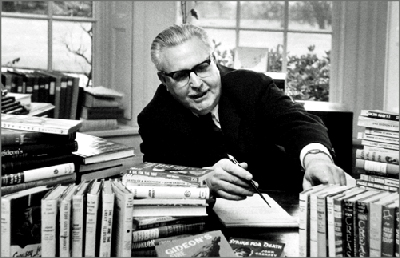
Writers Born Today - John Creasey

It's the birthday of John Creasey, born September 17, 1908 in England. He came from a working class family, and work he did. Depending on who you ask, he wrote somewhere between 560 and 620 novels using more than two dozen pen names (as well as his own). A complete bibliography of his work has never been assembled, and even Creasey admitted he could not remember all of them.

A teacher suggested he would make a career as a writer when he was just 10 years old. He took the advice to heart and began writing while still a teenager. Despite his dedication, he was rejected over 700 times. In his early years he wrote while working odd jobs to support himself, and produced up to 7,000 words a day on average.

By 1935 he was writing full time and publishing several books a year under different pen names. (Book sellers complained that he monopolized the letter "C" on their shelves).

He created two famous and lasting protagonists, Richard Rollinson (the Toff), an amateur detective, and George Gideon of Scotland Yard. Both of these characters made their way onto film and television. 

In 1962 the Mystery Writers of America awarded him an Edgar for Best Novel for Gideon's Fire. The organization honored him again in 1969 by making him a Grand Master.

He sold over 80 million books by the time he passed away in 1973.

Sunday, July 12, 2015

Writers Born Today - Donald Westlake

It's the birthday of Donald Westlake, born July 12, 1933 in Brooklyn.

He started writing in his teens. While working as an usher in a movie theater he would invent different endings for the films in his head. His parents saw him as an architect but he saw himself as a writer.

So he wrote. And collected dozens of rejections. He must have had a tough skin because he kept writing. After 200 rejections his first story was published in a science fiction magazine.

He wrote some more. Along the way he created one of the toughest character in crime fiction, a professional criminal named Parker. Yet Westlake didn't anticipate Parker becoming a series. As Westlake stated "When Bucklyn Moon of Pocket Books said he wanted to publish The Hunter, if I’d help Parker escape the law at the end so I could write more books about him, I was at first very surprised. He was the bad guy in the book."

Eventually, two dozen Parker novels were published.

In addition to his own name, Westlake produced stories and novels using 17 pseudonyms (including a female name, Barbara Wilson). Sometimes his pen names appeared in his fiction as characters. Westlake had a great sense of humor and he used it often in his writing. His most famous pen name was Richard Stark, used to create the Parker novels.

More than a dozen films have been made from his work, starring some of Hollywood's biggest stars. Director Quentin Tarantino has mentioned Westlake's fictional anti-hero Parker as an influence on his films, particularly Reservoir Dogs.

Westlake's screenplay for The Grifters was nominated for an Academy Award, and won an Edgar from the Mystery Writers of America for Best Motion Picture Screenplay. It was his third Edgar award.  In 1993, MWA made him a Grand Master.

He never made the new York Times best-seller list, but his influence in crime fiction cannot be overstated. Stephen King dedicated his novel Joyland to him. One writer even named his son after one of Westlake's characters...Parker.


Monday, June 8, 2015

Writers Born Today - Sara Paretsky

It's the birthday of Sara Paretsky, born June 8, 1947 in Ames Iowa.  She moved to Kansas as a child when her father got a job as a professor at the University of Kansas in Lawrence. Segregation was still the order of the day, and her family had to get a house in the country because realtors wouldn't sell a house in town to a Jewish family.

Her older brother Jeremy taught her to read. But as the only daughter much of the housework fell on her shoulders. She blossomed after leaving Kansas for Chicago, the setting for many of her novels. The first, Indemnity Only, came out in 1982 and introduced the world to Private Eye V.I.Warshawski. Mystery fiction would never be the same. She was one of the first writers to create a series around a strong professional female protagonist who could solve crimes without the help of a man.

Paretsky helped change the way women were treated in the publishing world, and she set the stage for the emergence of many other female writers in the mystery genre. She, along with a group of other women writers who had attended the first Women In The Mystery conference, created Sisters In Crime in 1986.

In 2011, the Mystery Writers of America awarded her the Grand Master for her contributions to the mystery genre.

Her latest V. I. Warshawski novel, Brush Back, will be published in July and is already getting rave reviews.

To read the story about the origins of Sisters In Crime, clickety-click here.

Thursday, May 1, 2014

Mystery History - The First Edgar Award

The presentation of the 2014 Edgar Awards is just a few hours away. By late evening or early morning, we'll know the winners.

But do you know who won the very first Edgar given for Best First Novel in 1946?

Meet Sgt. Julius Fast, who was still in the army when his debut novel, Watchful At Night, was published. Fast's protagonist suspects the accidental shooting of an army buddy was really murder, and follows a trail of clues to uncover a domestic spy ring.

The novel got good reviews (the Saturday Review called it "well worth reading") and it was selected as the winner of the first Edgar Award in June 1946 by the newly created Mystery Writers of America. The award included a special leather-bound edition of "The Portable Poe" by Viking Press. The now classic Poe Statues given out tonight hadn't been created yet.

Other awards were given for Best Picture of a Mystery Nature, to Murder, My Sweet (based on the Chandler novel Farewell, My Lovely), Best Radio Mystery Program (it was a tie between The Adventures of Ellery Queen and Mr. and Mrs. North), and Best Mystery Criticism to Anthony Boucher for his reviews and commentary.

I wish all the nominees Good Luck, and for the attendees, you have an exciting evening ahead of you. For the rest of us, I'm sure we'll all be watchful at night until the winners are announced.

Sunday, April 27, 2014

Mystery Weekend Roundup for April 27, 2014

Got Writer's Block? I've Got Three Words For You

Take A Hike!

That's right. Get up off your chair and talk a little stroll. It's the perfect way to get those creative juices flowing again, according to an article in the LA Times by Deborah Netburn (who presumably was able to overcome her own to give us this great news story).

Psychologists who tested volunteers found that their creative output surged by 81 %  when walking. So if you're stuck in a rut, get out there and leave some rubber on the trail. For more on this news scoop, clickety-click here.


Upcoming Events

MWA Anthology Launch Party

The Mysterious Bookshop in New York City is hosting a party on Tuesday April 29th to celebrate the launch of MWA's newest anthology: Ice Cold - Tales of Intrigue From the Cold War. Hosts are Jeffery Deaver and Raymond Benson. All the finest writers and spies are attending. Be there, or risk being left out in the cold. For the details, click here...then destroy the evidence.


International Spy Museum

The party continues on May 3rd in Washington, D.C. where Raymond and Jeffery will talk about the anthology and sign books. The secret code is here. Be sure the spread the news around. The NSA already has. Starts at 1 PM EST (Evil Spy Time).


The Edgar Awards Presentation

The mystery event of the year, presentation of the Edgars by the Mystery Writers of America, will take place on May 1st at the Grand Hyatt Hotel in New York City. Here's a list of the nominees. There will be a banquet starting at 7:30 PM followed by the award ceremony. It looks to be a great evening with great writers. But that's not all.

On April 30th, Oline Cogdill, 2013 recipient of the Raven Award, will interview the Grand Masters, Robert Crais and Carolyn Hart, at the hotel in the Broadway Room at 5 PM. Click here for details.

Reservations required for both events.

By the way. the Raven Award is given for outstanding achievement in the mystery field outside the realm of creative writing. And here's the 2013 Raven Award Presentation made to one of the most respected mystery critics in the business.


In The World of Thrillers, The Sleeping Dragon Has Awakened

Nearly one in six persons on planet Earth is Chinese. Yet very few mysteries or thrillers from that nation have found their way to the West. Communism was partly to blame. Crime fiction was banned until 1979. That's beginning to change. Mystery fiction has exploded in the past few years. And some of it is being translated to English. Some if it is very good.

Say hello to Mai Jia, best-selling author of seven spy novels, with five million copies in print. One of his novels, Decoded, has been translated into English and has won high praise (The New York Times Book Review has called it "a page turner" and the Independent declared it "A mixture of Kafka and Agatha Christie . . . An utterly fascinating read").


Just as fascinating is the author himself. He spent 17 years in the People's Liberation Army, some of it with an intelligence unit. Besides dealing with the usual writer's problems of getting published, his family suffered during the Cultural Revolution and his father was condemned as a criminal. His novel was rejected 17 times, and even after publication was banned for a time. But he persevered. Now he writes full time and cannot imagine any other life.

"I am addicted to the occupation just like drug addicts are addicted to drugs", he says. To read more about Mai Jia, check out the Wall Street Journal's blog Asia Scene.


Monday, March 31, 2014

Mystery Weekend Roundup for March 30, 2014

Hank Phillippi Ryan Interviews Rosemary Harris

New England Sisters in Crime has a great interview of Rosemary Harris on their website as part of their Writers At Work series. Rosemary Harris is the author of five novels, including Pushing Up Daises, which was nominated for the Agatha and Anthony awards. Hank Phillippi Ryan is an investigative reporter and award winning writer of several thrillers, including The Wrong Girl.

Rosemary shares with us some great writing techniques that help her put words on paper. 


Spring Is Here! Bring On The Books

The Rap Sheet put up a schedule of new crime novels being released over the next two months, including works by Hilary Davidson and Benjamin Black. You can see the list here, and read what J. Kingston Pierce has to say about some of his favorites at his Kirkus column, Spring Breakouts


Come in From The Cold...Ice Cold, That Is

The Mystery Writers of America has a launch party for their new short story anthology, Ice Cold coming out in April. The event is hosted by The Mysterious Bookshop in New York City on April 29th. Celebrate with tales of mystery and intrigue from the Cold War. Get more info at the facebook event page here. The collection is edited by best selling authors Jeffrey Deaver and Raymond Benson. Further updates will be released on a "need to know" basis. And that's all the information you need to know.


How One Determined Man Made A Difference (Or Shall We Say, A Definition)

Steve Parks proved that one man can make a difference when his lobbying efforts paid off after more than 10 years. He convinced Merriam-Webster to add the term "Yooper" to its dictionary. Yooper, as anyone should know, is a term used to describe a resident of the upper peninsula of Michigan, a population known for "being resilient, looking out for your neighbors, and working hard." Read more about this victory for readers everywhere at the Wall Street Journal.

Wednesday, November 27, 2013

60 Years Ago Today, The Long Goodbye is Published

In 1953, after several years of struggle, Raymond Chandler's novel, The Long Goodbye, came to print. He wrote the book while nursing his wife through an extended illness, which eventually took her life. It had a profound impact on Chandler. His last years alone were marked by alcohol abuse and loneliness.

The Long Goodbye is one of Chandler's most personal stories, and he put a lot of his own suffering into the characters. He told his agent, "you could not know the bitter struggle I have had in the past year to achieve enough cheerfulness to live on, much less to put into a book."

Anthony Boucher gave the book a rave review in the New York Times, and declared it one of the best private eye novels ever written. Today it is recognized as a classic work of art and helped cement Chandler's reputation as a great writer. In 1955 the Mystery Writers of America awarded The Long Goodbye an Edgar for Best Novel.


"To say goodbye is to die a little."

                     from The Long Goodbye